
Higher efficiency
SiC MOSFETs switch with lower losses than IGBTs, so more of the input power reaches the battery.
The truck, battery, and charger are engineered together. That’s where the BYD material handling story begins.

Lithium iron phosphate chemistry is at the heart of the BYD equipment lineup. A Battery Management System monitors the battery and coordinates operation with the truck and charger.
Explore battery technologyOpportunity charging lets you plan charging around available breaks. Your dealer can match the battery and charger to your power supply, shift pattern, and energy demand.
See the new chargerBYD supplies the truck, battery, and charger as an integrated platform. Equipment selection starts with the complete application, from your first load to your last shift.
Explore the featuresFrom the operator’s grip to the battery cells, every feature is designed to make the shift safer, easier, and more productive.

Large operator assist grips are designed to meet the needs of various operator sizes.

Optional fingertip controls increase productivity and reduce operator fatigue.

Gives operators speed control of the heaviest and lightest loads.

Great visibility through the mast. The low-profile front cowl also results in enhanced forward visibility.

Slope hold keeps the truck from rolling after the brake is released on a ramp or slope. Stability control reduces the chance of losing a load and roll-over.

Weatherproof dual 3-phase AC brushless motors produce high power and torque and allow greater maneuverability.
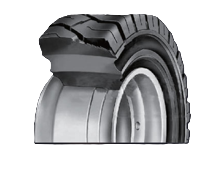
Solid pneumatic tires are ideal for even the harshest terrain.

BYD’s iron phosphate battery retains 70%+ capacity after 10,000 cycles and lasts over 15 years, with no replacement needed within the life expectancy of the truck.
Features and options vary by model and configuration. Confirm availability for your equipment with your dealer.
BYD’s newest charger generation replaces the IGBT switching of earlier models with silicon carbide (SiC) MOSFET power electronics. The result is higher efficiency, cooler operation, and electronics built for long-term reliability.

Figures for the 480 VAC model, DC80V200A-480UL.
SiC MOSFETs switch with lower losses than IGBTs, so more of the input power reaches the battery.
Less heat to manage inside the cabinet, supported by forced air cooling and a dedicated heatsink assembly.
Lower thermal stress on the power electronics supports dependable, long-term charging performance.

The new BYD charging gun adds two safeguards right at the point of connection.
An electronic latch locks the gun in place while the battery is charging, so it can’t be unplugged mid-charge. This protects the operator, the connector, and the battery.
Sensors in the connector monitor temperature and reduce charger output if it climbs too high, helping prevent damage to the charging system.
Full product specification for the three-phase industrial charger.
The charger monitors its input, output, temperature, and charge time, and stops safely when a limit is reached.
If the charger output is short-circuited, the charger shuts down and displays an error code.
If the battery is not connected or is reversed, the charger shuts down and displays an error code.
If input voltage drops below the preset level or a phase is lost, output stops and an error code is displayed.
If input voltage exceeds the preset level, output stops and an error code is displayed.
If the charger’s temperature exceeds the preset limit, output stops.
If output current exceeds the preset level, the charger shuts down and displays an error code.
If output voltage exceeds the preset level, the charger shuts down and displays an error code.
When the battery is fully charged, the charger stops output and shows that charging is complete.
If charging time exceeds the preset limit, the charger shuts down automatically.
Specifications for the 208 VAC charger are available from your dealer.
Talk to an expert
A compact charger that plugs into an ordinary wall outlet. Wherever there is power, the truck can charge: at the dock, in a back room, or at a job site with no charging infrastructure at all.
The charger plugs into a standard single-phase outlet, the same kind you already use for office and shop equipment. There is no three-phase supply to run, no dedicated charging room to build, and no electrician visit to schedule before the first charge.
Plug in at the end of the shift and the truck is ready when the next one starts. Charging happens during hours the truck would sit idle anyway, so there are no battery swaps, no spare batteries to manage, and no changeover time lost in the middle of the day.
BYD iron phosphate batteries need no watering or equalizing, and are backed by a 10-year battery warranty, subject to terms.
See warranty coverageFull product specification for the single-phase portable charger.
For extreme conditions, specify your local environment requirements when ordering.
BYD LFP batteries do not need watering or equalizing. Plan appropriate charging and regular equipment inspections with your dealer to keep the operation moving.

BYD equipment supports opportunity charging with a compatible charger. The right charging plan depends on the selected battery, charger, supply power, and daily energy use. Your dealer can assess the application.
BYD chargers are available for 110 V, 208 VAC, and 480 VAC input. Requirements vary by charger. Confirm input voltage, phase, current, and installation requirements for the exact charger before planning electrical work. The 110 V portable charger runs from a standard single-phase outlet.
Start with your operating hours, load profile, travel distances, temperatures, and available charging windows. These details help your dealer size the system for your work.
Ask your dealer for the current warranty document for the specific equipment and battery configuration. Coverage, time and hour limits, exclusions, and capacity conditions depend on the applicable terms. See warranty coverage